The Netherlands Student Intifada Archiving Project
This website provides an overview of the material collected by the Netherlands Student Intifada Archiving project. View the index, or read more about the project below. If you would like to request any material, or have other questions, get in touch via email.
The Amsterdam student encampments
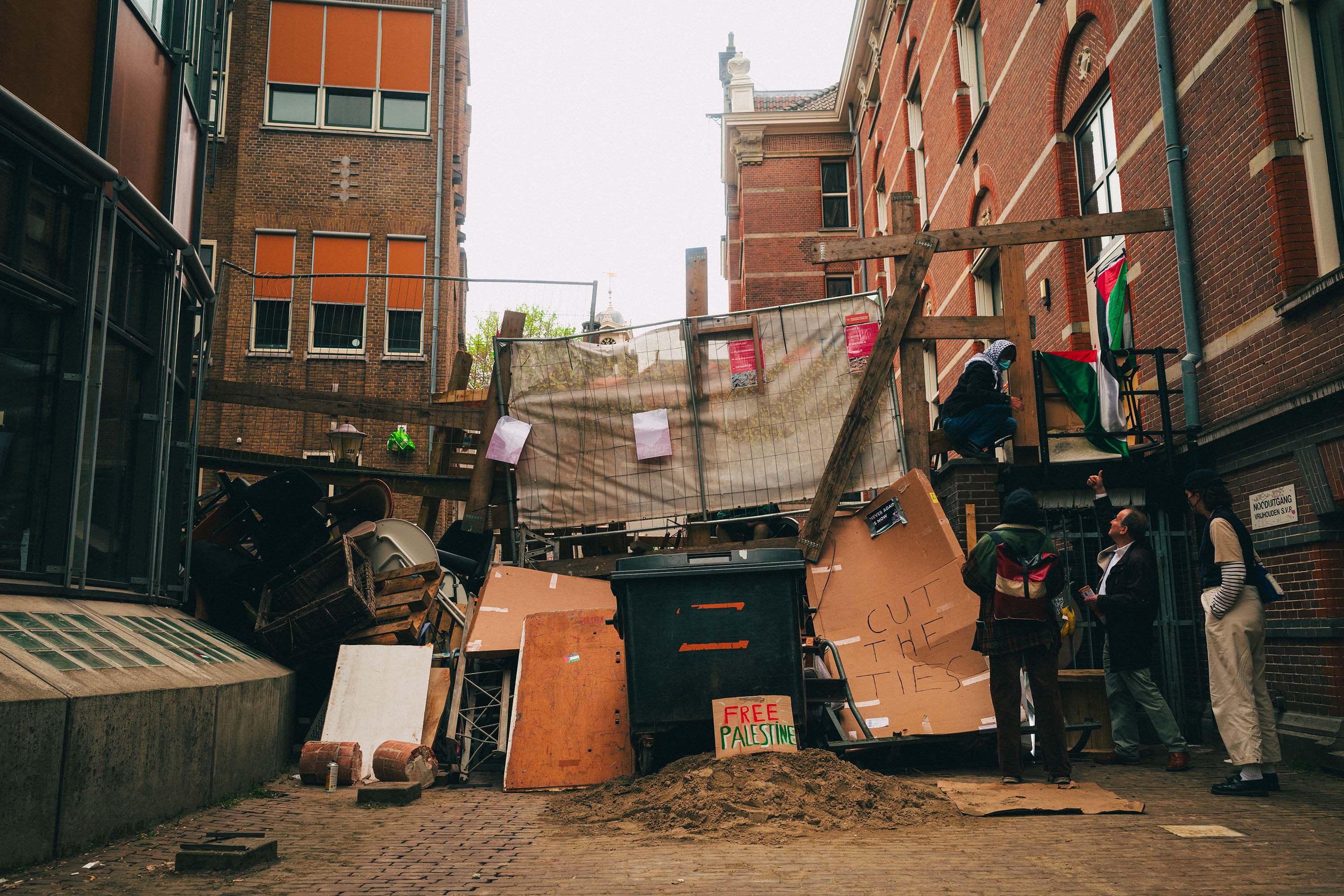
In May 2024, students of the University of Amsterdam pitched their tents in the middle of their campus and organised the first protest encampment for Gaza in the Netherlands. Thousands of people were mobilised in support of Palestine. They organised numerous protests denouncing the complicity of the Dutch state in the ongoing genocide in Gaza by the settler-colonial apartheid state of Israel. The first university occupation, on the lawn of the Roeterseiland campus, was violently evicted the same night when police bulldozers broke through the protesters’ defensive barricades. A second occupation, of the city centre campus, lasted two days, mobilising even greater numbers of protesters than before and attracting a huge amount of media attention. The eviction, again carried out by bulldozing through the barricades with protesters still on them and defending them, triggered a massive protest in the city. The movement itself became national, and in the following weeks and months, encampments sprang up throughout the country, in nearly every university town in the Netherlands.
The Netherlands Student Intifada Archiving Project
As the protests were ongoing, a coalition of action groups – Amsterdam Student Encampment, Workers for Palestine, Samidoun, Mokum Kraakt and UvA for Palestine started an initiative to collect and centralise documentation of the events. Initially, the idea was to focus on evidence of police violence. But it quickly grew into a bigger project which sought to preserve the memory of the uprising, to shape the narrative, and to learn tactical lessons for future protests. This became the Netherlands Student Intifada Archiving Project. A self-hosted and secure website was launched where participants in the protests were invited to upload their footage, photos, and written testimonies of the events, contributing to a sprawling, collectively self-made archive containing hundreds of entries. The project proved its worth when its contents were used in the defence of protestors who faced trial. In addition, some of the images and written testimonies were included in the book Between Palestine and us: testimonies of the 2024 student uprising in Amsterdam, published by Spookstad in 2025.
Archive index
The original coalition of action groups has tended to the archive since its inception. As we wanted to maintain secure use of the collected materials, we have never made them openly accessible, and we never will. At the same time, the purpose of the archive was and remains to be used to the advantage of the movement. To strike a balance between security and actual use, we are now, two years after the events, publishing an index of the contents of the archive online. This index offers descriptions of nearly all the items in the archive, which anyone is free to browse through. This allows you to get an idea of what is in the archive, and what might be helpful to you and the movement, be it for a court case, research into police violence, or a more creative project. Access to the material itself can be requested by emailing us. Please motivate your request by making clear how your project is beneficial to the movement. We do this for the sake of transparency and accountability, to facilitate research and to further public (historical) awareness of events. We would love to hear from you if you want to contribute to these goals!
view the index →What is in the index?
This index is derived from information uploaded by people via the previously openly accessible upload form on this website. An option for usage consent was added to the upload form at a later stage. A data file has been exported and manually organised using OpenRefine data cleaning software. The index contains the following information: record id, city, date of events, time of events, location, tags, description, media description and time of the upload.
What is not in the index?
In order to safeguard anonymity, some information and categories are not publicly available. Any deleted text is indicated with [omitted]. Deleted information includes:
- The attached media
- Links to websites or media
- Any sensitive or personal information
- Any information that could identify the uploader
- Descriptions of appearances, or pointing out of persons in the footage (that aren’t cops)
- Descriptions of acts that could be used against any of the involved parties in a court of law (that aren’t cops)
- Any record that contains a request for anonymity or explicitly revokes usage consent
Determination of time
Dates and times are based on the input given by the uploader. These inputs vary in format, range and certainty (i.e. a description of the time may be "not sure"). For usability purposes the values have been duplicated and reconciled to the format of 00:00. Whenever descriptors such as “afternoon” or “post-eviction” are used, a guesstimate of the time based on the events is given. “Not sure”/not mentioned were changed to unknown or n.a., as are records that don’t pertain to a specific moment, i.e. records of bruises after police violence, or scans of flyers.
Locations
Locations are based on the input given by the uploader. These inputs also vary in specificity, naming conventions and spelling. For this category misspelling and abbreviations were changed to full locations (i.e. REC or BG1 were changed to Roeterseiland Campus or Binnengasthuis). Indicators such as “around” and “near”, and other descriptions of locations remain authentic.
Tags
Via the form the uploader could add tags to their testimony. There was a list of suggested tags, but uploaders could also add tags themselves. All tags – both suggested and self-made – are used in the index.
How to use the index
The entries in the index can be filtered by city and category using the buttons at the top of the page. They can be displayed either as a table, useful for viewing multiple entries at once, or as a list, suited to reading the longer descriptions that some entries include. In table view, any column can be sorted ascending or descending by clicking the respective header. The entries can be searched using the search field.